I posted this poem in February 2010. Thought I'd bring it to the front of the room again.
God give us men! A time like this demands
strong minds, great hearts, true faith, and ready hands;
Men whom the lust of office does not kill;
Men whom the spoils of office cannot buy;
Men who possess opinions and a will;
Men who have honor - men who will not lie;
Men who can stand before a demagogue,
And damn his treacherous flatteries without winking!
Tall men, sun-crowned, who live above the fog,
In public duty and in private thinking;
For while the rabble, with their thumb-worn creeds,
Their large professions, and their little deeds,
Mingle in selfish strife, lo! Freedom weeps,
Wrong rules the land, and waiting Justice sleeps.
by Josiah Gilbert Holland
American writer (1819-1881)
This poem is from a popular American literature textbook for high school students, published in 1935 and used through the 1940's.
It isn't read today, I'm sure. After all, it is the work of that dreaded historical figure, the Dead White Male.
______________________________________________________________
Showing posts with label cultural. Show all posts
Showing posts with label cultural. Show all posts
Tuesday, November 20, 2012


Tuesday, April 27, 2010
Maintenance Man!
Call him that, or janitor, or custodian, but the people who keep the workplace clean and whole perform a vital service. It is no small thing to maintain man's structures and machines from the assault of Time and Nature. These are occupations that do not obtain a status equal to their value.
The daily routine of cleaning and sanitation serves to keep us healthy.
The oiling of hinges, tightening of screws, replacement of bulbs and fuses, the sharpening of blades, the testing of alarms, flushing, charging, breakdown & reassembly, cleanup, disposal, collection, refill, restore, replace, alter, modify and renew: all these activities and more keep the social engine running.
Custodians are a kind of hero forming an aboveground resistance in the war to maintain stability which is the sea our ideas swim in.
_______________________________________________________________________________________
The daily routine of cleaning and sanitation serves to keep us healthy.
The oiling of hinges, tightening of screws, replacement of bulbs and fuses, the sharpening of blades, the testing of alarms, flushing, charging, breakdown & reassembly, cleanup, disposal, collection, refill, restore, replace, alter, modify and renew: all these activities and more keep the social engine running.
Custodians are a kind of hero forming an aboveground resistance in the war to maintain stability which is the sea our ideas swim in.
_______________________________________________________________________________________
Sunday, March 7, 2010
Voice from the New Bourgeoisie
West Palm Beach artist Ralph Wolfe Cowan:
"My aim is to reflect contemporary man's ultimate desire for self-expression and living on the edge. The latest in technology is how today's individuals define themselves and separate themselves from one another. Even the lack of clothing is a statement of stepping out of established moral and social boundaries."
His subjects sport exotic tattoos, designer clothing and the latest de rigueur accessories. His pictures also include meteors being pulled to earth by helium balloons, and there are mysterious symbols etched in sand and rocks. He explained: "They represent how society is re-examining its belief and understanding of the world, turning it inside out to see new possibilities."
From an article in Palm Beach Post, by Gary Schwan
Where are the philistines when you need them?
_______________________________________________________________________________________
"My aim is to reflect contemporary man's ultimate desire for self-expression and living on the edge. The latest in technology is how today's individuals define themselves and separate themselves from one another. Even the lack of clothing is a statement of stepping out of established moral and social boundaries."
His subjects sport exotic tattoos, designer clothing and the latest de rigueur accessories. His pictures also include meteors being pulled to earth by helium balloons, and there are mysterious symbols etched in sand and rocks. He explained: "They represent how society is re-examining its belief and understanding of the world, turning it inside out to see new possibilities."
From an article in Palm Beach Post, by Gary Schwan
Where are the philistines when you need them?
_______________________________________________________________________________________
Saturday, March 6, 2010
The avant garde
The term avant-garde is not used much these days. At least I don't find it in the reading I do. Thinking about that, I wondered if one should say the term is dead, or perhaps the avant-garde has won. It does seem that all art more than a year old is passe and valueless in the aesthetic sense. Much art may continue to sell and draw huge auction prices but very little of it seems to be spoken of as innovative or challenging.
What risks are there for the artist today? There are no barriers to self-expression, no statement too outrageous, no subject so vapid, no color so misused, no space so filled with dross, that art cannot find a way to transform it into its green web of commerce.
Today, in museums and galleries, we are confronted with art works that look like materials left on the floor for the sweeper. But this distribution of materials is intentional. The jumble of wire, the splintered axe handle, the fine layer of sawdust, the irregular stack of newspapers are meant to speak to us by the unusual, even outrageous presence of their incongruity. There is meaning here if we will give ourselves the unbiased chance to discover it.
Once the avant-garde artist flouted the norms of our culture and provoked us to feel and to think about how we see the world and how we spend out lives. It remained moderately successful on the margins and was useful as a catalyst to the mainstream world of art.
Now the outrageous is the norm. The avant-garde is the New Bourgeoisie.
____________________________________________________________________
What risks are there for the artist today? There are no barriers to self-expression, no statement too outrageous, no subject so vapid, no color so misused, no space so filled with dross, that art cannot find a way to transform it into its green web of commerce.
Today, in museums and galleries, we are confronted with art works that look like materials left on the floor for the sweeper. But this distribution of materials is intentional. The jumble of wire, the splintered axe handle, the fine layer of sawdust, the irregular stack of newspapers are meant to speak to us by the unusual, even outrageous presence of their incongruity. There is meaning here if we will give ourselves the unbiased chance to discover it.
Once the avant-garde artist flouted the norms of our culture and provoked us to feel and to think about how we see the world and how we spend out lives. It remained moderately successful on the margins and was useful as a catalyst to the mainstream world of art.
Now the outrageous is the norm. The avant-garde is the New Bourgeoisie.
____________________________________________________________________
Monday, February 22, 2010
What To Believe
A well-known golfer has reported that he needs to return to the Buddhist teachings that he learned as a child. This return, he believes, will assist him in his efforts to restore his standing with his family and the society in which he lives. If only it were that simple.
It might be more useful to explore why and how he left those Buddhist principles. The problem may not be what to believe, but how.
There is no lack of systems or programs for people to follow in order to stay on the correct moral path. We have the teachings of the classics, the fables of Aesop, the parables of Jesus, the Ten Commandments.
We even have the 10 Cowboy Commandments, by Gene Autry. A good cowboy:
1. must not take unfair advantage of an enemy.
2. must never go back on his word.
3. must always tell the truth.
4. must be gentle with children, elderly people and animals.
5. must not possess racially or religiously intolerant ideas.
6. must help people in distress.
7. must be a good worker.
8. must respect women, parents and his nation's laws.
9. must neither drink nor smoke.
10. must be a patriot.
That's a worthy set of instructions for holding to the social covenant.
No, the real problem for this golfer, for each of us, is not what to believe, but how.
Henry David Thoreau wrote "It is best to avoid the beginnings of evil."
That's a start. Somehow, in the mashing messiness of daily life fueled by steroidal thought and tremendous economic pressures, each of us must stay attuned to the inner voice which calls from the past and says "Hold on. This is not what you promised to do or be."
I am no student of Buddhist teachings. I have read a little on the subject and the most apparent quality of it seems to be the concept of not craving things or attachments outside one's self. That is a difficult task. There are so many wonderful and exciting things that are desirable.
I believe this golfer's road to the future was split into two paths from the start. Believe the Buddha and be the greatest golfer in the world. Those two objectives seem incompatible. A good place to begin his quest.
______________________________________________________________________
It might be more useful to explore why and how he left those Buddhist principles. The problem may not be what to believe, but how.
There is no lack of systems or programs for people to follow in order to stay on the correct moral path. We have the teachings of the classics, the fables of Aesop, the parables of Jesus, the Ten Commandments.
We even have the 10 Cowboy Commandments, by Gene Autry. A good cowboy:
1. must not take unfair advantage of an enemy.
2. must never go back on his word.
3. must always tell the truth.
4. must be gentle with children, elderly people and animals.
5. must not possess racially or religiously intolerant ideas.
6. must help people in distress.
7. must be a good worker.
8. must respect women, parents and his nation's laws.
9. must neither drink nor smoke.
10. must be a patriot.
That's a worthy set of instructions for holding to the social covenant.
No, the real problem for this golfer, for each of us, is not what to believe, but how.
Henry David Thoreau wrote "It is best to avoid the beginnings of evil."
That's a start. Somehow, in the mashing messiness of daily life fueled by steroidal thought and tremendous economic pressures, each of us must stay attuned to the inner voice which calls from the past and says "Hold on. This is not what you promised to do or be."
I am no student of Buddhist teachings. I have read a little on the subject and the most apparent quality of it seems to be the concept of not craving things or attachments outside one's self. That is a difficult task. There are so many wonderful and exciting things that are desirable.
I believe this golfer's road to the future was split into two paths from the start. Believe the Buddha and be the greatest golfer in the world. Those two objectives seem incompatible. A good place to begin his quest.
______________________________________________________________________
Monday, February 8, 2010
TV For Thinkers
In the August 2000 edition of the Palm Beach Post, there appeared a small ad for a TV show that was so over-the-top that I had to cut it out to save it (and savor it). Here it is:
TV FOR THINKERS
Bash ( Showtime, Monday, 8 P.M.)
Calista Flockhart, Paul Rudd and Rod Eldard star in three dramatic monologues by writer-diretor Neil LaBute that artfully and thoughtfully plumb the depths of modern-day depravity and despair.
No comment necessary.
______________________________________________________
TV FOR THINKERS
Bash ( Showtime, Monday, 8 P.M.)
Calista Flockhart, Paul Rudd and Rod Eldard star in three dramatic monologues by writer-diretor Neil LaBute that artfully and thoughtfully plumb the depths of modern-day depravity and despair.
No comment necessary.
______________________________________________________
Friday, February 5, 2010
Media Misconduct
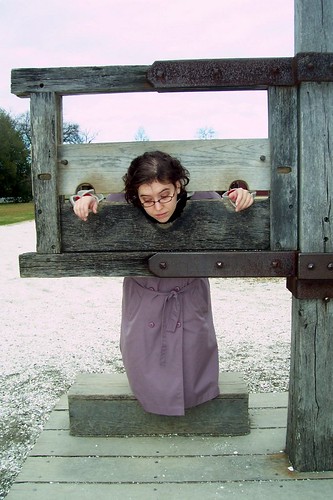
Today there is a very different method for punishing those who offend the taste of the social arbiters of America, said arbiters being the media, the pundits, the bloviators, the gasbags, and yes, I dare say, the assholes who pollute the airways with their views and news.
Today the offender's face is on the TV screen. Sitting in our living rooms we can watch the punishment, shame, and embarassment as the tape of the transgressions is played repeatedly. Old transgressions committed years ago are shown again and they talk of 'a pattern here'.
When a question is raised about the propriety of these activities, the defenders state that the reporters are asking "legitimate questions". I wonder about that expression. What is a 'legitimate' question? For that matter, what is an 'illegitimate' question? Anyone? Anyone?
Over the past few decades, the Media has grown in power and influence.
Today when a movie is released, the major stars sit for an entire day to be interviewed either in person, by telephone, or via closed circuit TV in 20 to 30 minute segments with "Entertainment Reporters" all around the country. These appearances are mandatory.
In the sport of tennis, when a match is completed the players go to a press room and sit to be questioned by reporters about their game, their feelings about the game, their health, their mood, etc, etc, etc. These press appearances are mandatory subject to fines if not done.
As a rule most questions are insipid and boring and useless. The answers are tiresome cliches and boring. Why wouldn't they be?
The best that reporters can hope for is that someone will get upset and make a 'gaffe'. (Oh how they love that word.) When a gaffe is made, the Media smell blood and move to feed on it like the parasites they are.
______________________________________________________________
Monday, February 1, 2010
On The Making of Lists
There are two very popular subjects (which are also pastimes) that I find useless, and even destructive in a passive way.
They are the Lists Of Ten Best this or that and, a corollary, the naming of the Best Novel of the Year, or the Best Actor, or Best Movie, or Best Play. All these choices and decisions are subjective. There are standards applied, of course, and often a committee or board of nominating peers make the selections based on their expertise and knowledge. But personal taste and bias play a role, whether admitted or not.
Certainly, for the general public, the choices are received solely in terms of one’s subjective response. “Oh”, one will say, “that was the best book of the year”. But another will say, “No way. Many books were better than that one. I don’t know how it got nominated.”
Recently there were many lists of different kinds due to the end of both a year (2009) and a decade (the Noughts). This timely occasion produced scores of lists in the newspapers, magazines, websites, and blogs.
The Ten Best Movies of the Year. The Ten Worst Movies of the Year. The Ten Best Movies of the Decade. The Ten Worst Movies of the Decade. And so it went on and on for category after category. You get the picture.
I realize that these lists and contests are marketing tools designed to keep the public interested and increase sales. Other than the resultant cheapening of our intellectual life, there is nothing wrong with that.
However, an outgrowth of this was the appearance of a plethora of lists on various blogs that made the process look absurd. These lists tended to be in the literary field because books are the main subject of many blogs.
So we were treated to the Five Best Spy Novels, Five Best Crime Novels, Five Best Novels about teachers, Five Best Novels about faith, Five Best Novels about War, and so on and on and on.
These blogs of which I write are managed by educated and intelligent people with very good minds. Nearly everything that appears on their blogs is rewarding and useful. So I commented to one blog and expressed my opinion about lists. The response from the blogger and some of his readers was that they knew this very well, but they found the making of these lists enjoyable and felt it created situations for discussion that would increase sociability.
So there it was again. I held the correct opinion but the wrong position. I didn’t see opportunities for socializing. Well, that’s true. But, then, I can’t remember when I ever did.
I should do something about that. I'll put it on the list.
________________________________________________________
They are the Lists Of Ten Best this or that and, a corollary, the naming of the Best Novel of the Year, or the Best Actor, or Best Movie, or Best Play. All these choices and decisions are subjective. There are standards applied, of course, and often a committee or board of nominating peers make the selections based on their expertise and knowledge. But personal taste and bias play a role, whether admitted or not.
Certainly, for the general public, the choices are received solely in terms of one’s subjective response. “Oh”, one will say, “that was the best book of the year”. But another will say, “No way. Many books were better than that one. I don’t know how it got nominated.”
Recently there were many lists of different kinds due to the end of both a year (2009) and a decade (the Noughts). This timely occasion produced scores of lists in the newspapers, magazines, websites, and blogs.
The Ten Best Movies of the Year. The Ten Worst Movies of the Year. The Ten Best Movies of the Decade. The Ten Worst Movies of the Decade. And so it went on and on for category after category. You get the picture.
I realize that these lists and contests are marketing tools designed to keep the public interested and increase sales. Other than the resultant cheapening of our intellectual life, there is nothing wrong with that.
However, an outgrowth of this was the appearance of a plethora of lists on various blogs that made the process look absurd. These lists tended to be in the literary field because books are the main subject of many blogs.
So we were treated to the Five Best Spy Novels, Five Best Crime Novels, Five Best Novels about teachers, Five Best Novels about faith, Five Best Novels about War, and so on and on and on.
These blogs of which I write are managed by educated and intelligent people with very good minds. Nearly everything that appears on their blogs is rewarding and useful. So I commented to one blog and expressed my opinion about lists. The response from the blogger and some of his readers was that they knew this very well, but they found the making of these lists enjoyable and felt it created situations for discussion that would increase sociability.
So there it was again. I held the correct opinion but the wrong position. I didn’t see opportunities for socializing. Well, that’s true. But, then, I can’t remember when I ever did.
I should do something about that. I'll put it on the list.
________________________________________________________
Tuesday, January 26, 2010
Charles Laughton
At the top of My Blog List (to the left) is a site called About Last Night, an intelligent and literate site that I go to often to see what the provider, Terry Teachout, has to offer.
Today, in a post called A Great Actor Reads, it has the recorded voice of Charles Laughton reading for an audience .
Please check it out. In the first one, he reads from Jack Kerouac's book The Dharma Bums. I was struck by how much the reading reminded me of the Dylan Thomas poem Fern Hill.
What a voice Laughton had!
____________________________________________________________
Today, in a post called A Great Actor Reads, it has the recorded voice of Charles Laughton reading for an audience .
Please check it out. In the first one, he reads from Jack Kerouac's book The Dharma Bums. I was struck by how much the reading reminded me of the Dylan Thomas poem Fern Hill.
What a voice Laughton had!
____________________________________________________________
Friday, January 22, 2010
Last Words
While rummaging through my desk drawer this morning, I found a tag from a tea bag that I had removed and saved some months ago because I found it humorous.
The following is printed on the tag:
"Don't let it end like this. Tell them I said something."
Pancho Villa,
last words
(1877-1923)
Poor Pancho.
I recall how, in the long ago past, one would see or read the 'last words' of famous people in any number of places: books, magazines, newspapers, etc.
Was it the mystery or fear of death that made people hover at deathbeds waiting for some sign that the dying person could see ahead to the other world?
Perhaps they expected a tidy summing up of the dying person's life experiences and they might be given some wisdom, a rule for life.
But I can't recall seeing the last words of anyone who had died since, say, 1950. I wonder why.
My guess is either they die so quickly they don't have a chance to speak, or they are so filled up with pain-killing drugs that the mind and speech organs won't work.
Poor Pancho. Had a chance but was at a loss for words.
________________________________________________________________________________________
The following is printed on the tag:
"Don't let it end like this. Tell them I said something."
Pancho Villa,
last words
(1877-1923)
Poor Pancho.
I recall how, in the long ago past, one would see or read the 'last words' of famous people in any number of places: books, magazines, newspapers, etc.
Was it the mystery or fear of death that made people hover at deathbeds waiting for some sign that the dying person could see ahead to the other world?
Perhaps they expected a tidy summing up of the dying person's life experiences and they might be given some wisdom, a rule for life.
But I can't recall seeing the last words of anyone who had died since, say, 1950. I wonder why.
My guess is either they die so quickly they don't have a chance to speak, or they are so filled up with pain-killing drugs that the mind and speech organs won't work.
Poor Pancho. Had a chance but was at a loss for words.
________________________________________________________________________________________
Saturday, April 4, 2009
Golden Age of TV
The Golden Age of Television fell between the years 1949 and 1961, although some would date the end as early as 1954. What made it Golden? There were several reasons, among them the presentation of original plays, adult drama theater on a weekly basis, variety shows that brought us the older performers as well as new talent, and most productions were live, actors acting in real time before live audiences.
There was a higher cultural output than has been seen since and it all appeared on the three major networks.
All that I have just written is well documented and in greater detail than I need to do here. I raise the subject to make note of one program which never gets mentioned in any history of this time in TV.
I don't remember the name of the program nor in what year it appeared although it was the 1950's. The program was hosted by the actor James Mason and included his wife Pamela and one guest, Richard Burton. The set was a private library with a few easy chairs, wall shelves filled with books and a stepladder. The three actors would take turns reading passages from novels and plays, or poetry from the great poets of the past.
For a young man who grew up in rural farm country this kind of show was magical and I have never forgotten how these three people treated literature with great attention and respect.
My one specific memory is of Richard Burton (his turn to recite having come round) climbing the ladder to take down a book and returning to stand on the floor. He opened the book, turned some pages, said "Ah", and began to read aloud one of the sonnets of John Keats. I can still hear the deep rich Welsh voice begin: "When I have fears that I may cease to be Before my pen has glean'd my teeming brain...."
There was a higher cultural output than has been seen since and it all appeared on the three major networks.
All that I have just written is well documented and in greater detail than I need to do here. I raise the subject to make note of one program which never gets mentioned in any history of this time in TV.
I don't remember the name of the program nor in what year it appeared although it was the 1950's. The program was hosted by the actor James Mason and included his wife Pamela and one guest, Richard Burton. The set was a private library with a few easy chairs, wall shelves filled with books and a stepladder. The three actors would take turns reading passages from novels and plays, or poetry from the great poets of the past.
For a young man who grew up in rural farm country this kind of show was magical and I have never forgotten how these three people treated literature with great attention and respect.
My one specific memory is of Richard Burton (his turn to recite having come round) climbing the ladder to take down a book and returning to stand on the floor. He opened the book, turned some pages, said "Ah", and began to read aloud one of the sonnets of John Keats. I can still hear the deep rich Welsh voice begin: "When I have fears that I may cease to be Before my pen has glean'd my teeming brain...."
Subscribe to:
Posts (Atom)


